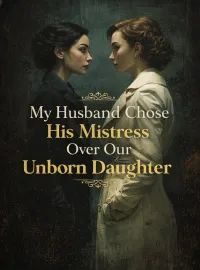
My Husband Chose His Mistress Over Our Unborn Daughter
8.2 / 10.0
Share
Trapped in a penthouse that feels more like a cage, a heavily pregnant woman watches her husband's messages turn distant, then chillingly sweet. Brendan's late nights and a new, uncharacteristic heart emoji spark dormant instincts she can't ignore. Pulling up the security feed, she braces for a truth that could shatter her world—and put her unborn daughter at risk.
My Husband Chose His Mistress Over Our Unborn Daughter Summary
Trapped in a penthouse that feels more like a cage, a heavily pregnant woman watches her husband's messages turn distant, then chillingly sweet. Brendan's late nights and a new, uncharacteristic heart emoji spark dormant instincts she can't ignore. Pulling up the security feed, she braces for a truth that could shatter her world—and put her unborn daughter at risk.
Read More
My Husband Chose His Mistress Over Our Unborn Daughter Chapter 1
I pressed my hand against my still-flat stomach as Dr. Patel's voice echoed in my mind. 'Everything looks perfect, Mrs. Mendez. Strong heartbeat, normal development.' The ultrasound photograph felt warm in my purse—a small, black and white miracle that had made me cry in the sterile examination room. After years of trying, after the loss that had left a permanent scar on my body and my heart, we were finally having a baby. I allowed myself to believe, for the first time in months, that our life together was still worth something.
The Seattle afternoon light filtered through our penthouse windows as I settled onto the cream leather couch, my fingers tracing the edge of the ultrasound photo. I pulled out my phone, scrolling through the local anonymous forum I sometimes checked for neighborhood news. The usual posts about lost dogs and street closures filled the screen until one thread made me stop breathing.
'**Spotted this adorable family at Pioneer Square! #DadGoals**'
The photograph showed a man with familiar dark hair and broad shoulders. My husband. But it wasn't his face that made my hands tremble—it was his arm, wrapped around a delicate, doe-eyed woman with honey-blonde hair. A three-year-old boy with Rhys's chin sat on his shoulders, laughing. The caption continued: 'This dad has it all! Perfect wife, perfect kid, perfect life!'
My phone slipped from my fingers, clattering onto the marble coffee table. The late nights. The Portland 'business trips.' The way Rhys had stopped looking at me when he kissed my forehead. It all clicked into devastating focus at once, like a puzzle I'd been refusing to solve.
That evening, I heard his key in the lock at 8:47 PM. Rhys walked in, his tie loosened, the scent of unfamiliar perfume clinging to his collar. He bent down, pressing his lips to my forehead with mechanical habit.
'How was your day?' he asked, already loosening his cufflinks.
'Fine,' I said, my voice steady as I stirred the pasta I'd made. 'The baby's heartbeat was strong. Dr. Patel said everything looks perfect.'
'Good,' he replied, not meeting my eyes. 'I have calls to make.'
I nodded, swallowing the scream building in my chest. My thumb found the old knife scar on the back of my left hand—the permanent reminder of the night I'd thrown myself in front of a blade meant for him. The night we'd lost our first baby. The night he'd held me in a hospital bed and promised we'd survive anything together.
After dinner, I cleared the dishes while he disappeared into his home office. When the house grew quiet, I sat at the kitchen island, the ultrasound photograph pressed flat beneath my palm. I stared at the tiny form of our child—the baby I'd nearly died to conceive—and wondered if Rhys would still want to be a father if I confronted him.
The next evening, I told him I was meeting Indy for dinner. Instead, I drove to Lake Union at dusk, to the waterfront condo we'd dreamed of buying in our broke college days. 'Someday,' he'd whispered, pointing to the building as we walked hand-in-hand along the water. 'When we make it big.' Now, we could buy ten of them.
I parked across the street and waited. The blue glow of evening settled over the water as a familiar black Audi pulled up. Rhys stepped out, then reached back to help a woman from the passenger seat. Melanie. Even from a distance, I could see her delicate features, the way she leaned into his touch as he placed his hand on the small of her back. He carried grocery bags as they walked inside, their silhouettes framed by the warm light of the condo.
I sat motionless, watching until the lights went off. Then I drove home, tears falling silently down my cheeks. That night, I removed my wedding ring and placed it in a drawer, the metal cool against my skin.
Two days later, Indy arrived unannounced, Thai takeout in hand and suspicion in her eyes. She'd seen my unanswered texts, noticed the way I'd stopped returning her calls.
'You're not eating,' she observed, setting down the bags. 'And you keep touching that scar. What's going on, Sar?'
I shook my head, but she wasn't having it. Indy had survived her own brutal divorce two years ago; she recognized the signs I couldn't voice.
'You already know, don't you?' she said quietly. It wasn't a question.
For three seconds, my composure cracked. Then I rebuilt it, brick by painful brick. 'I don't know what you're talking about,' I lied.
But Indy saw through me. And in that moment, I realized I couldn't keep pretending—not to her, and maybe not to myself anymore.
Continue Reading
My Husband Chose His Mistress Over Our Unborn Daughter of Contents





New Release Novels

9.4
Born under a crimson moon, I was branded a curse by my pack. They feared my presence, eventually sealing my wolf and leaving me powerless. My life took a dark turn when I was forced into marriage with Drogo, a merciless rogue Alpha suffering under a divine punishment. He is a man of shadows and terror, yet I hold a dangerous secret. I possess the exact likeness of the woman from his past who caused his eternal downfall and continues to haunt him.

9.0
Irene has loved Alpha Anderson for twelve years, believing they were fated mates. However, during their sacred marking ceremony, Anderson publicly rejects her to claim Leah as his true Luna. He dismisses his previous bond with Irene as a mistake, choosing to exchange vows with another under the Frostmoon. Witnessing this betrayal from the shadows, Irene decides to finally release him. Yet, as she prepares to depart, her absence begins to unravel the Alpha in unexpected ways.

8.9
Faced with a forced arranged marriage from her father, she reaches out to her boyfriend, Pietro Moretti, in a desperate bid for salvation. Instead of comfort, Pietro coldly accuses her of deception and refuses to discuss commitment until his "sister," Luna, is settled. Shattered by his callous rejection and realizing she has lost her bet, she finally surrenders to her family's demands. She turns to her father, ready to accept the wealthy match she once fought so hard to escape.

9.6
Eager to share her life-changing pregnancy news, she arrives at James's office only to witness a devastating sight: her husband passionately kissing his secretary. To make matters worse, she overhears James cruelly dismissing her as nothing more than a pitiful stray and a pet. Shattered by his callous betrayal and the realization that her marriage was a lie, she silently retreats. Returning to their home, she packs her belongings, determined to escape his shadow and build a new life far away.

7.8
A brutal beating ruins Rafael's lifelong dream of playing basketball. While his mother and sister put on a show of grief and assemble top medical care, their tears are nothing but a facade. Half-conscious in the car, Rafael overhears a shocking confession: his own mother orchestrated the assault to sabotage his fitness test and clear a path for Cliff. Offering him the corporate empire as compensation cannot heal his broken spirit. His perfect family is a web of absolute betrayal.

8.0
A decade of devotion ends in public humiliation on the day of her investiture as Noble Consort. After accidentally wearing the late Empress's ceremonial gown, she is met with cold indifference by her husband of ten years, who dismisses her as a cheap imitation. Worse, the young princess she raised for a decade turns on her in disgust, burning her handmade blessing charm. Shattered by their cruel betrayal, she finally speaks her truth: she never desired to replace anyone, nor did she ever want the crown.