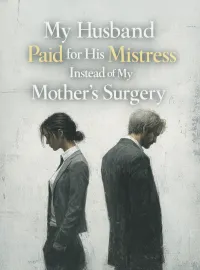
My Husband Paid for His Mistress Instead of My Mother’s Surgery
8.3 / 10.0
Share
As her mother lies on the brink of surgery, a wife grips her husband Flynn's hand, desperate for comfort. But his cold fingers and distracted gaze reveal a truth she can't yet grasp. When the bills arrive, she learns where his money truly went—to another woman. This betrayal ignites a reckoning that will redefine everything she thought she knew about love, loyalty, and her own strength.
My Husband Paid for His Mistress Instead of My Mother’s Surgery Summary
As her mother lies on the brink of surgery, a wife grips her husband Flynn's hand, desperate for comfort. But his cold fingers and distracted gaze reveal a truth she can't yet grasp. When the bills arrive, she learns where his money truly went—to another woman. This betrayal ignites a reckoning that will redefine everything she thought she knew about love, loyalty, and her own strength.
Read More
My Husband Paid for His Mistress Instead of My Mother’s Surgery Chapter 1
The fluorescent lights buzzed above me, too bright, the kind of white that makes everything look like a memory before it's even happened. I was flat on the gurney, a blue paper gown swallowing my body, an IV taped to the back of my hand. My other hand was curled loosely around Flynn's fingers. I remember thinking his hand felt cold. I remember thinking that was strange, since he was always the warm one.
"They're taking me back soon," I said. My voice came out smaller than I wanted.
Flynn didn't answer. His phone buzzed against his thigh, then buzzed again. He glanced down, and something in his jaw shifted.
"Everything okay?" I asked.
"It's fine," he said, too fast. The phone buzzed a third time. He turned it over so I couldn't see the screen, but I'd already seen the name. Ariah. Six letters I'd learned to brace against, the way you brace for weather.
"Flynn."
"I have to take this." He wasn't looking at me. He was already looking at the door. "She says she's about to faint. Low blood sugar or something. I'll be right back."
I was about to go into surgery. I had lost our baby three days ago and my body hadn't caught up with the loss yet, and my husband was standing up, sliding his hand out of mine like it was a coat he no longer needed.
"Okay," I said. Because that was what I always said. Okay.
He didn't kiss my forehead. He didn't tell me he loved me. He just walked, and the door swung shut behind him with a soft, final click, and I lay there and looked at the empty chair until a nurse came in and told me it was time.
I faced the operating room alone. I want to say I cried, but I didn't. I just went very still, the way you do when you're trying not to feel something all the way to the bottom.
He came back hours later, when I was already in recovery, groggy, my mouth dry as chalk. He smelled like a perfume that wasn't mine — something floral and expensive, the kind of scent that clings to a person after they've stood close to someone else for a long time.
"Hey," he said, checking his watch before he checked my face. "How are you feeling?"
"Tired," I said. There was a folder on the tray beside me, thick with paperwork the hospital had left for discharge. I picked it up and held it out. "Can you sign these? The liability forms. They need it before they release me."
He didn't open it. He didn't read a single line. He took the pen from the clip, flipped to the tabbed pages, and scrawled his name three times, fast, the way he signed everything that bored him. His phone buzzed again before the cap was back on the pen.
"I have to run out for a bit," he said. "Client thing."
I closed the folder over the divorce papers I had slid inside the liability forms that morning, back when I still had enough of myself left to plan something instead of just endure it. I said nothing. I stared at the ceiling tiles and counted them until he left.
The days after, I moved through our apartment like a woman doing inventory of a house that had already burned down. I photographed bank statements. I copied wire transfers into a folder I encrypted and named something boring, something he'd never think to open. Flynn barely noticed. He thought I was grieving quietly, and I let him think that, because it was easier than explaining I was done grieving and had moved on to something colder.
Then Ariah came to our home.
She let herself sit at my kitchen island like she'd done it a hundred times, accepted a glass of wine without a thank you, tilted her head at Flynn with a smile made of sugar and steel. "I've been looking at apartments on the Upper East Side," she said, eyes never leaving him. "Would you come look at one with me this weekend?"
Flynn laughed — a nervous, guilty sound — and said nothing to stop her. Nothing at all.
I set down the spatula. I untied my apron. I took off my wedding ring and placed it on the counter between them, and neither of them said a word as I walked away.
That night, I found the number. A commission statement, five point two million dollars, deposited into his account a month earlier — two weeks before I had knelt in front of him crying, begging him to help me pay for my mother's heart surgery.
"We're stretched thin this quarter, babe," he'd told me. I'd believed him.
I cross-referenced the wires. Payments to an account under Ariah's name. A luxury lease. Designer boutiques. My mother had died believing there was no money in the world to save her.
My hands did not shake. I closed the laptop and sat in the dark for a long, long time, and when I finally stood up, I was not the same woman who had sat down.
Continue Reading
My Husband Paid for His Mistress Instead of My Mother’s Surgery of Contents






New Release Novels

8.1
After three years of a cold, transactional marriage to high-powered CEO Grant Sterling, Eloise Thorne finally requests a divorce to escape her suffocating existence. However, her former lover reappears, arrogantly claiming her as his possession. To her shock, Grant refuses to let her go, stepping in with unexpected ferocity to defend his wife. As the billionaire's hidden possessiveness ignites, Eloise must navigate a dangerous game of obsession and buried secrets.

9.1
Mario Chandra’s life as a fitness star collapses when his ex-wife and manager leaves him destitute. Facing sudden financial ruin, he receives a surprising proposal from a wealthy widow and former gym client named Inez. Desperate for stability, Mario agrees to become her contract husband. Will their arrangement remain a cold business transaction, or will genuine passion ignite between the former trainer and his benefactor? Discover their journey in this tale.

9.5
To preserve her father's legacy and save his company, Olivia enters a strategic marriage with the cold, powerful billionaire Ethan Cohen. What begins as a rigid business arrangement soon shifts as genuine feelings surface between the unlikely pair. Amidst corporate schemes and family secrets, they must navigate the thin line between their formal contract and a budding romance. Will their artificial union transform into a lasting love?

8.8
When billionaire Josiah Broadway ignores a ten-million-dollar ransom to celebrate with his mistress, his own mother pays the ultimate price. Callously believing the hostage is his mother-in-law, he refuses to pay and lets her perish. Following the recovery of the disfigured body, he demands the corpse be delivered to a studio to serve as a realistic prop for a performance. His wife, fueled by silent fury, obeys his grim request. He Thought My Mother Died, but It Was His explores a deadly mistake.

8.5
Cast out and left to die by her own mate, Selene was meant to become a forgotten memory. Instead, the mysterious Rogue King rescues her, sparking a path of rebirth. Driven by a mysterious prophecy surrounding her daughter’s glowing moonmark, Selene rises from the shadows to build a new empire. Haunted by strange visions and pursued by dangerous cults, she must navigate a treacherous world to claim her ultimate destiny and make her enemies remember her name.

8.6
After three years together, Finn Shore betrays Rosaline on Christmas Eve by drugging her and selling her to settle a massive debt. He believes her resemblance to a powerful man's obsession is his ticket to freedom. However, his plan takes a dark turn when Rosaline wakes up in the estate of Wesley Olson, her own uncle. Since Wesley has only ever loved Rosaline's mother, Finn has unwittingly delivered his victim to the one man who will make him pay for his crimes.